Showing posts with label My Games. Show all posts

Tuesday, October 9, 2012

Four Phases

This is the second part of something.  Here's part I.

Lay Track - Phase I

At the start of your turn, your team should have three track cards laying face-up in your factory.  During this phase, you and your teammate move one or more track cards from your factory onto the game grid.  A track card can be placed onto any tile of the game grid that is not already occupied by a cart or a pit card.  This mean that teams have the option to lay track cards on top of existing track cards.  Any orientation of the track card is allowed so long as the track card occupies only one tile.

At the start of the game, teams can only lay one track card per turn.  The number of track cards a team is allowed to lay per turn can be increased if teams achieve specific objectives during play:
  • For two track cards per turn: One of your team's carts (not the gold cart) must move at least three spaces in a single turn.
  • For three track cards per turn: One of your team's carts (not the gold cart) must move at least five spaces in a single turn.  See phase III for details on cart movement.

When laying down track cards, a team must lay down all allotted track cards.  This means if your team has earned the ability to lay down three track cards per turn, you must lay down all three track cards every turn (not one or two).  This phase ends once you and your teammate has laid all of your allotted track cards.

Pull Lever - Phase II

During this phase, you and your teammate must decide which of the colored tiles (green, orange, fuchsia) to place the switch on.  This decision plays a critical part during the next phase of play.

Move Mine Carts - Phase III
  • For the first turn of the game, your mine carts will be positioned inside your towns.
  • To move a cart out of a town and onto the board, the cart must "hop" onto a track that has made a connection to the town.  The image below shows three track cards that have made a connection to a red town.  Note: This cart can only hop onto the green colored track if the switch had been placed on the green tile during the previous phase.

A Town And Some Tracks

  • Once a track has been hopped onto, your cart follows the path created by connecting tracks until no more track exists to follow.
  • When a junction is encountered, the cart must follow the track colored the same as the tile the switch occupies.  The switch should have been placed during the previous phase.

A Junction

  • If the color of the tile the switch occupies is not present on the junction track card, the card follows the black track by default.
  • When your cart reaches the end of the path it is traveling, your cart comes to a rest on the tile containing the last piece of track that was part of the path.  A cart should never occupy a tile on the game grid where track has not been laid.

Sample Movement - Before & After

  • On your next turn, your cart will begin on the length of track your cart came to rest on during the previous turn.
  • If a path exists for your mine cart to travel on, your cart must move this phase.  This rule includes the case of moving your cart out of your town and onto the game grid.
  • Each team controls two carts.  These carts are labeled "1" and "2."  The order that a team moves carts is important.  First, the "1" cart moves.  Next, the "2" cart moves.  Finally, the gold cart moves.

Special notes on cart movement:
  • The edges of the game grid wrap on all four sides.  The simplest way to grasp this concept is to think of the game Pac-Man.  In Pac-Man, when a player leads Pac-Man off one side of the screen, he emerges from the opposite side of the screen.  The same concept applies here.

Wrapping - Before & After

  • Carts cannot pass through each other.  If the path of one cart is blocked by another cart, the moving cart will come to a halt on the tile before the collision world occur.

Blocking - Before & After

  • If your cart begins phase III on a colored section of a junction track, the position of the switch (green, orange, fuchsia) does not affect your cart's ability to move off this length of track onto a connecting path.
  
Discard/Draw - Phase IV

During this phase, discard all remaining track cards (if any) in your team's factory.  Draw three new track cards from the deck, and place these new cards face-up in your team's factory.

Play now passes to the opposing team.

Cheers,

Danny

Thursday, October 4, 2012

Mine Cart Mayhem

Last week, I posted about my first prototype for a race game I spent some time working on.  After its first playtest, I threw that prototype into a pot with some additional playtests and a plethora of unremarkable art skills, and a game started brewing.  It's been a few weeks, and I need the counter space, so I'm going to go ahead and serve this game up whether it's ready or not.  Here's the first part of a write-up detailing what's in the pot.

This is going to be wordy, and I can't promise it'll be entertaining.  I want to better my ability to convey game mechanics through text.  It's an exercise I've done a few times before, and each of those times sucker slapped me in the face with a surprising amount of challenge.  It's hard.  I want to improve.

So, if you're not feeling this, this isn't for you.  This is for me.  Thanks for understanding.


Mine Cart Mayhem - A Race Game

The year is 1893.  You live in a small Colorado town that didn't exist before the Colorado Silver Boom.  For 14 years, your town prospered.  Then, with little warning, the boom ended.  Most towns in the area have been abandoned.  Your own town is a shell of its former self.  Lining your town's borders, miles of crisscrossing railroad tracks lie in disarray.  Once used to shuttle precious metals, now they exist to rust.  Your town is poor, but worse than that, your fellow townspeople have grown despondent.

Hope looms on the horizon, however!  Word has just come in that a golden mine cart has been spotted a few miles outside of town, resting on some of the out-of-service tracks.  Where did it come from?  An eccentric philanthropist, perhaps.  Who knows?  Not you!  No more time for questions!  Bringing this golden mine cart back to your town could be just what the townspeople need to lift spirits that have been falling for years.

The objective:
You and your teammate must lay down track and build a path that will lead the golden mine cart from the abandoned tracks to the open arms of your town's people.  Securing this treasure will bring pride and prosperity back to your town.  Hurry though!  It seems the golden glimmer has caught some hungry eyes from a neighboring town.  It's a race to see who can guide the golden mine cart back to their town first.  It's a game of gold and wits!  The race is on!

Game components:
  • 1 game board
  • 2 red mine cart game pieces
  • 2 blue mine cart game pieces
  • 1 gold mine cart game piece
  • 1 track switch game piece
  • Game cards (track cards and pit cards)

The Game Board

The Game Pieces

The Card Types

Setup:

Lay the game board out flat on a hard surface.  Pick a location where each of the four players can sit along a different edge of the game board.  A small, four-sided table is ideal.

From this point on, all mine cart game pieces will be referred to as follows: color + "cart".  For instance, "gold cart" references the golden mine cart game piece while "red cart" references one of the red mine cart game pieces.  The track switch game piece will be referred to as the "switch."

Place the gold cart on the center tile of the game grid.  This center tile is the only tile with tracks printed on it.

Lines, both black and colored, printed on the game grid and game cards are called tracks (see "The Card Types" image above).  When tracks on adjacent tile connect, a path is formed (more on this later).

Place the switch on any of the three colored tiles (green, orange, fuchsia) found on the game board next to the game grid.  Your color selection at this point is not important as you will be given the opportunity to move the switch during your first turn of play.

The remaining four carts get placed on the four towns, one cart per town.  The colors of the town must match the color of the cart placed onto it.  For instance, a red cart cannot be placed on a blue town.

Remove the four pit cards from the deck of game cards.  Pit cards have a black hole printed on their faces.  Shuffle the deck of track cards, and then lay the deck face-down on the game board on top of the space labeled "deck."

Next, each player takes one pit card and places it onto an empty tile of the game grid.  The only restriction on placing these pit cards is that pit cards may not be placed on the four tile surrounding the tile the gold cart occupies.  The tiles marked with red X's in the image below cannot have pit cards placed on them.

Nope!

Make sure your game grid contains four pits before proceeding.

Each team draws three cards from the deck and lays them face-up on the their factory spaces.  Factory spaces are the spaces with images of factories printed on them.  There are six factory spaces - three for each team.  The factory spaces attached to your team's town is your team's factory.

Order of play:

The game is played with four players separated into two teams of two players each.  The red team controls the two red carts, and the blue team controls the two blue carts.  Teammates share control over their carts and track cards.  Teammates are expected to communicate each turn and come to an agreement on the optimal moves to make.

To determine the order of play, all players must reveal their middle names.  Play starts with the team whose player has the most embarrassing name as determined by consensus.  Players who choose not to reveal their middle name automatically forfeit the chance for their team to move first.  If a starting team cannot be determined with the aforementioned middle name shenanigans, players must play a rote (read: not very fun) game of rock, paper, scissors to determine the order of play.

What does a turn look like?

Each turn is separated into four distinct phases:
  • Lay track
  • Pull lever
  • Move mine carts
  • Discard/draw

These phases will be described in detail in a future post.

Wordy.  I warned you.

Cheers,

Danny

Wednesday, September 19, 2012

Race Game Prototype

Here's the first prototype I playtested for a race game I'm making.

The Board

A Track Card

The pieces:
  • Four players
  • One board
  • A small stack of cards identical to the one pictured above
  • Four game pieces (one for each player) to keep track of player positions on the board

Players start the game on the shaded spaces at the two ends (lengthwise) of the game board.  So, both shaded spaces on the upper edge of the game board as well as both shaded spaces on the lower edge of the game board will be occupied by players at the start of the game.  At any point during play, players can only occupy the shaded spaces - a player should never come to rest on an unshaded space.  Play starts with a player determined by some arbitrary method, and then proceeds clockwise based on the players' starting positions.

On a player's turn:
  • He/she draws and places a track card onto one of the unshaded spaces of the game board.
  • Track cards may be placed on top of existing track cards.
  • The orientation of the track card is determined by the player at the time it is laid.
  • After the track card card has been laid, the player moves his/her game piece.
  • A player can move from his/her current shaded space to an adjacent shaded space only if a track card has been laid that connects the two spaces.
  • A player can only move once per turn.
  • If a move can be made, a player is not allowed to finish his/her turn without making a move.

Special considerations:
  • The left and right edges of the game board "wrap".  This means that a player who exits the game board on the right side will re-enter the game board on the left side, and vice versa.  If you find this concept confusing, think of how Pacman levels operate.  It is important to note that this wrapping occurs only on the left and right sides of the game board, not on the top and bottom.
  • Multiple game pieces cannot occupy the same space on the game board.  Game pieces can also not travel through other game pieces.  With these constraints in mind, it is possible to position your game piece to block an opposing player's movement.

The goal: The first player to successfully navigate his/her game piece to the opposite side of the game board (either of the two possible shaded spaces) from which he/she started is the victor.

Going into the playtest, I knew the game board was small.  My biggest worry was that players would complete the game in three of four moves.  What transpired was a surprisingly lengthy gameplay experience.  When a player was on the verge of winning, the other three players would coordinate their moves to stop the win and keep the game going.  Communication, coordination, teamwork.  None of these were things I considered when designing this prototype.

Coming out of the first playtest, I decided that I wanted to design the rest of the game to foster more of the communication I had just witnessed.  My first change: put the players on teams.  Rather than a free for all between four players, I wanted to pit two teams of two against each other.  This way, a single mind (teammates talking through possible moves) would have control over two game pieces.  This was the first of many changes to come.  Iteration is a beautiful thing.

Cheers,

Danny

Friday, September 7, 2012

Sunday

Musings from LD24 part V.

Sunday was tough.

I had finally settled on an idea, I had already made a handful of (very) small prototypes to test gameplay mechanics, Stencyl and I were beginning to understand each other, but the thought of working on my game didn't excite me like it did the previous 36 hours.

I was worried that my game wouldn't be any fun.

I'm sure thoughts like these aren't unique to me.  I imagine all game developer's run into similar thoughts, probably constantly, throughout the lifespan of their respective projects.  It's a tough wall to climb over.  I hope the wall gets shorter with experience, but my motivation took a pretty hard hit upon this first encounter.

Will my game be fun to play?

I couldn't think of a way to answer this question without first building my game out into a playable state, so that's what I did.  Slowly.

I knew the player character's abilities would improve and evolve over time, so I made a list of abilities I wanted to include:
  • Running speed
  • Jump height
  • Climbing (as in climbing up vertical faces)
  • Sliding (as in sliding down vertical faces to prevent death from falling)
  • Flying
  • Speed of movement underwater
  • Ability to breathe underwater

In hindsight, this list was ambitious.  I managed to squeeze in jumping and flying, but I scrapped everything else.

Another scrapped idea: I wanted to group NPCs into villages with each village specializing in a specific ability that would benefit the player.

Regardless of how short I fell of my ambitions, at the end of the weekend, I was damn proud of myself.  On Friday night, I set out to make a game, and by Sunday night, I was playing it!

That's it.  That's my Ludum Dare experience.  The way I've documented it, you'd think I had made something magnificent.  I don't expect anyone else to share my feelings, but when I look at my game, I do think it feels pretty magnificent.

Cheers,

Danny

Tuesday, September 4, 2012

Saturday

It's been a few days.  I'm not making excuses, but here's a pretty damn good excuse.

I got wrapped up in reading all of this and watching a lot of this.  It's been great.  I'm exhausted.

Musings from LD24 part IV.

I woke up Saturday morning, and for some reason, felt compelled to create animations for my game characters.  My characters were squares.  Not square as in describing their general shape.  Squares as in literal squares.  I settled on simple, geometric shapes for all my characters before the theme for Ludum Dare was even revealed.  This decision was a pragmatic one as I didn't want to spend time creating art assets when I could be spending that same time creating interesting and enjoyable gameplay.  For some reason, contrary to this reasoning, that morning, I wanted to plop some blinking eyes on all the squares.

I focused on two animations: blinking and breathing.  I guess I thought these animations would make my characters more cute and therefore more appealing.  Probably true, but on that Saturday morning, I didn't have a game made yet.  I barely even had an idea for a game.  I wasn't properly managing priorities, and in the end, I wasn't impressed enough by any of my animations to use them.  I got caught up in visual aesthetics.  Looking back, this time seems wasted.  It was a lesson I thought I knew, but I'm glad to have learned it firsthand.

Sometime in the afternoon, over the course of many lazy hours, I finally decided how my game would play.   Building from the generational idea I had previously, here's where I ended up:
  • The player character will age and die on a timer.  I was thinking of a 60 second lifespan.  After the first 30 seconds, the player grows too old to reproduce.
  • Every time the player character mates with an NPC, a new character is born that the player is given control over, and the life timer resets.
  • The player character improves with each generation that passes.
  • The player character's abilities that improve are dependent on which NPC characters are mated with.  NPCs live in clusters throughout the game world.  Each cluster possesses a unique ability.
  • Generally, the longer that player character survives, the faster that player character will be able to run, the higher that player character will be able to jump, and the longer that player character will be able to swim.
  • In addition, I wanted to include special abilities for the player character to attain such as flying, breathing underwater, and climbing vertical faces.
  • The entirety of the game world cannot be explored by the player unless that player evolves his/her player character through many generations improving his/her player character's abilities with each one.
  • The goal of the game is to survive for as long as possible.
  • The game will keep track of and display the number of generations that has elapsed.

Two new prototypes:

Here, the player character's jumping ability increases every time he/she jumps on an NPC.  Try to get the red "fruit!"

http://dl.dropbox.com/u/64097119/Stencyl/LD24%20Jump%20Higher%20Prototype.swf

Here, I figured out how to implement a simple head-up display.

http://dl.dropbox.com/u/64097119/Stencyl/LD24%20HUD%20Prototype.swf

Move left and right with the arrow keys.  Jump with X.

It didn't take long for me to realize how ambitious of an idea this really was.  Especially considering that at this point, I only had 24 hours before the competition ended.  It didn't matter, I was committed.

Cheers,

Danny

Thursday, August 30, 2012

LD24 Prototype

Musings from LD24 part III.

Friday, 11:06 PM.

I was still doubting my ability to create a compelling game experience from my color idea.  I knew dwelling on this doubt and uncertainty would only waste time, so, instead, I decided to prototype what I believed would be the primary mechanic  - two squares mating with each other.

First, I listed out everything I thought I'd need to implement in order to get this mechanic into a playable state:
  • I need to be able to detect when the player square is interacting (colliding) with an NPC square.
  • I need to be able to detect player keyboard input for movement and the "sex" command.
  • I need to create a new character on screen after the "sex" command has been input.
  • After this new character is created, I need to transfer player control from the currently controlled square to the new square.
  • I need to perform some process so that characters who have already mated cannot mate again.

Next, I opened up Stencyl and started learning.

A few hours of tinkering later, this popped out:

http://dl.dropbox.com/u/64097119/Stencyl/LD24%20First%20Prototype.swf

Move left and right with the arrow keys.  Jump with X.  Have sex with F.  You must be on top of an NPC square to have sex.

Cheers,

Danny

Down To Business

Musings from LD24 part II.

I decided to roll with the color idea I introduced in my last post.

I wanted my game to consist of a single, tall screen.  The initial game screen would contain only the player square and an NPC square.  Everything on screen, barring the two characters, would be a single, flat color.  Starting the game, the only thing the player would be able do is walk over to the NPC and mate with it.  Mating would produce a new character on screen that the player would immediately takes control of.  Along with the new character, every act of mating would cause new elements to appear in the environment.  Some of these elements would be purely aesthetic while others would serve as a means of helping the player explore more of the world that would exist off the top of the screen.  For instance, after the first act of mating, a series of platforms acting as a staircase would reveal themselves, encouraging the player to travel upwards off the screen in search of a mate for their new character.

The goal of this game was for players to explore the world.  Tasking myself with creating a world that players would genuinely enjoy existing in was daunting.

If you've played what I ended up crafting, you know the final product is far from this initial vision.  What happened?

That's a story for tomorrow (or the next day).

Cheers,

Danny

Monday, August 27, 2012

Brainstorming

Musings from LD24 Part I.

8 PM.

Evolution.

The first thing I did was make a list of things I think about when I think about evolution:
  • Pokemon
  • Spore
  • The Evolution movie with David Duchovny
  • (I drew a picture of a smily face with three eyes)
  • Now --> better
  • Neolithic Age
  • Hunter-gatherers --> farmers
  • Wolf --> dog
  • Water --> land
  • Metamorphosis
  • Mutation
  • Natural selection
  • Genetic drift
  • Simple --> more complex

My first idea came shortly after my last bullet point.  I wanted to make a game about the evolution of color vision in primates.  Weird.  Interesting.  I liked it.

I jumped into the Internet, and pulled out some research.

Evolution of color vision in primates
Primate Color Vision

Ability to perceive red and orange hues allows tree-dwelling primates to discern them from green.  This is particularly important for primates in the detection of red and orange fruit, as well as nutrient-rich new foliage, in which the red and orange carotenoids have not yet been masked by chlorophyl.

Another theory is that detecting skin flushing and thereby mood may have influenced the development of primate trichromate vision.

Taking this, I wanted to make a side-scrolling platform game about colors.  To start, the game world would consist of a single color.  As the player progressed, more and more colors would populate the world.  These colors would represent new obstacles, destinations, and points of interaction.  This was perfect for me because I could do colors without complex sprites or animations.  I was unsure how a player would unlock new colors for the world, however.  This lack of primary game mechanic put a pretty large hole in my idea and initial high.

Concurrently, I was playing with the idea of making a game about forming communities.  The Neolithic Age was a turning point in human civilization as that was when farming became a widespread practice.  With farming came large, settled communities of people.  This community building was a huge step in the evolutionary process to modern man.  I liked the big picture idea, but no interesting ideas for a game came to me from it.

All of this happened in the first 90 minutes.  Like I said yesterday, it'll take me a few days to recount my Ludum Dare experience in full.

Cheers,

Danny

Sunday, August 26, 2012

Evolution

Here's my submission for Ludum Dare 24.

The theme was Evolution.

http://dl.dropbox.com/u/64097119/Stencyl/LD24%20Submission.swf

Move left and right with the arrow keys.  Jump with X.  Have sex with F.

I learned a lot.  I'll be ruminating for the next few days.

Note: I didn't actually submit my game into the Ludum Dare competition.  I just used the competition's theme and deadline as a motivator.

Cheers,

Danny

Wednesday, August 15, 2012

Cadence

The challenge: Design a board-game adaptation of any video game.  This game should be playable without the player having to design anything!

My first idea was to turn Mario Kart into a board game.  Mario Kart lends itself perfectly to a race to the finish-style game, and most of the elements from the digital game could be directly ported to a physical game with little abstraction.  While not difficult to get a prototype up and running, I think creating a genuinely fun board game from Mario Kart would prove challenging, but I wanted to try something less obvious.

My second idea was to transform the battle and progression systems of Paper Mario into a card game.  I had a lot of ideas, but ultimately, I felt like my game design was  becoming too similar to a card game called Munchkin.  Because of the similarities, I decided not to pursue this idea.

For some reason, the next game the jumped on my brain was Amplitude.  If you derive any kind of joy from rhythm games, you need to track down a copy of Amplitude!


Amplitude is set in a future where street lanes represent musical instruments, and each lane is studded with copious amounts of music nodes.  In this future, people don't drive cars, they drive magic, music-generating vehicles.  These vehicles have the power (some argue the responsibility) to hit the music nodes as they hover over them.  Every hit node adds a beat or note to the song.  If a vehicle hits enough nodes in sequence on a single lane, that lane will jam all by itself for a while.  In Amplitude, the player is given control over one of these vehicles and is responsible for hitting the nodes.  The idea is for the player to hop between lanes, nail the patterns, get the music going, and keep as many elements of the song playing for as long as possible before the song and level ends.  Within each lane nodes can take one of three positions.  Buttons on the controller are mapped to these positions.  Blah, blah.

That's Amplitude.  It's awesome!

After reading about a bunch of alternate reality games in Reality Is Broken, I wanted to create a game that forced players to interact in a very direct manner.  I wanted to crate a social experience.  What I was looking to do, I didn't know how to do with a card or board game, so this design is a little out there.  I took some liberties with the challenge rules by not making a board game, but the idea beckoned.  Who am I to ignore?  The game is simple, requires little setup, and if it plays anything like it does in my head, there should be a lot of laughing.  You'll need a metronome, three or more friends, and enough space to wiggle your limbs about.

For those not in the know, a metronome is a device used by musicians to keep time.

It might look like this.

Or this.

In Cadence (My game has a name!), one player takes on the roll of the magic, music-generating, hovering vehicle while every other player (there really isn't an upper limit) takes on the roll of a lane.  The lane players stand in a row facing the vehicle player.  The goal of the game is for the vehicle player to simultaneously activate as many of the lane players as possible which in turn will create many layered rhythms.  It'll sound beautiful, I promise.

In order for the vehicle player to activate a lane player and get some music going, he/she must first choose a lane player to face off with.  The vehicle player can only face off with a single lane player at a time.  During a face off, the lane player performs some action that the vehicle player must mimic.  Before starting the game, players may place restrictions on the actions a lane player may do, but as far as I'm concerned, anything goes.  Actions can include dancing, singing, hugging a stranger, sprinting to a nearby tree, or even scaring a small child who got just a little too curious about the teenagers having fun in the park.  Whatever the lane player does, the vehicle player has to copy if he/she wants to activate that lane.

This game isn't played with any hard and fast rules, so the success or failure of the vehicle player's mimicry is determined by the lane player who initiated the action.  Upon failure, the vehicle player may attempt the action again or move on to an unactivated lane.  Once the vehicle player has completed the action, the lane player who owns that action starts clapping a pattern to the timing of the metronome.  Clapping continues for as long as the lane player deems appropriate (again, no hard and fast rules).  The vehicle player hops between lane players, mimics their actions, and by doing so, adds more clapping patterns to the mix.  Each lane player must clap a different pattern.

Lane players may also change the action they want mimicked every time the vehicle player comes to them for a face off.  This includes the scenario where the vehicle player attempts to copy the lane player, fails, moves on to a different lane, and then comes back to the original lane player for another go.

Again, the goal of the game is to create music from different clapping patterns.  The music gets more complex the more lanes get activated.  The game continues for as long as they players want to keep playing, or until one of the lane player wants to take a crack at being the futuristic, magic, music-generating, hovering vehicle.

I haven't had a chance to play Cadence yet outside of my head.  I know, I know.  90 percent of the battle is iteration.  But, as you can probably imagine, Cadence can be a tricky idea to sell.  When I do convince some friends to play, I promise I'll film it.

Cadence is a synonym for rhythm, so that's where the name comes from.  Also, to me, cadence sounds serene.  I like the dichotomy between what cadence sounds like and the craziness of the gameplay.

Cheers,

Danny

Sunday, August 5, 2012

Courage

Here's my newest Twine story:

http://dl.dropbox.com/u/64097119/Twine/Courage.html

I'm calling this project Courage.

Story statistics:
  • 49108 characters
  • 6955 words
  • 47 passages
  • 102 links

This story is much more personal than the last one I made.  It means something very specific to me, but I think it's something everyone can relate to.

I don't think the story can be understood after only one playthrough, so I encourage everyone to play multiple times.

Let me know what you think!

Cheers,

Danny

Saturday, August 4, 2012

WWI Part IV

I spent more time writing about my WWI-themed game these past few days than I spent playtesting and iterating.  Moving forward, this isn't something I want to make a habit.  I enjoy documenting my progress on this blog and am beginning to understand the importance of writing as it relates to game design and development, but writing isn't as fun as making games.

I'm still not sure how fun or playable my game is (not enough playtesting!), but I am proud of the ways in which the game mechanics relate to the theme.  Before I started designing anything, I knew I wanted to make a game about life in the trenches during WWI.

The way shells fall on the battlefield represents the randomness of life and death in war times.

The way a soldier in the trenches can be replaced with a soldier from the deck with little consequence represents how the individual life of a soldier is undervalued.  It is not important who fights and dies so long as someone fights and dies.

An able-bodied soldier, even when directly on top of a wounded soldier, is incapable of identifying the wounded soldier's allegiance without deliberate investigation.  On all sides of war are people, and all people are destroyed by war equally.

After a set number of turns has elapsed, all wounded soldiers remaining on the battlefield perish.  At this point, nothing more can be gained by either side, yet shells continue to fall.  This represents how even after the fighting ends, war continues to destroy.  Soldiers carry what they saw and what they did with them forever.  For many, it becomes impossible to assimilate back into society after experiencing the horrors of war.

I like to think every mechanic listed was created for the reasons stated, but some of it might be bullshit with the help of hindsight.  It's hard to tell.

There is a lot of room here for further iteration.  For instance, I'd like to implement a mechanic that represents the lack of training young recruits frequently received.  This lack of training directly influenced their chances of survival.

Later.  Much later.  I'm tired of thinking about this game.

Cheers,

Danny

Friday, August 3, 2012

WWI Part III

If you haven't read parts I or II, none of these pictures will make sense.

Setup:


Separate the black and red cards.


Draw eight cards from each pile.


Shuffle these eight cards and lay out your battlefield.


Choose an origin point, x-axis, and y-axis for your battlefield.  Here, the origin is the space outlined, the x-axis runs along the upper edge of the battlefield, and the y-axis runs down the left edge.


Each player draws one card from their deck and places it in their trenches.  The areas representing the trenches are outlined.

First turn:


The black player moves his soldier from the trenches onto the battlefield.


The red player shuffles his soldier (3 of hearts) back into his deck and draws a new soldier.  This new soldier gets placed in the trenches and can do nothing further this turn.


Artillery shells fall at the end of every turn.  Two dice are rolled to determine where the shell lands on the battlefield.  This two represents the x-coordinate.


This six represents the y-coordinate.


The space outlined here is where the shell lands.  No able-bodied soldiers occupy that space, so the shell has no effect on gameplay.  Currently, only one soldier occupies the battlefield, so only one shell falls.  Four to five soldiers means two shells fall per turn.  Six to seven means three shells fall per turn.  And so on.

Second turn:


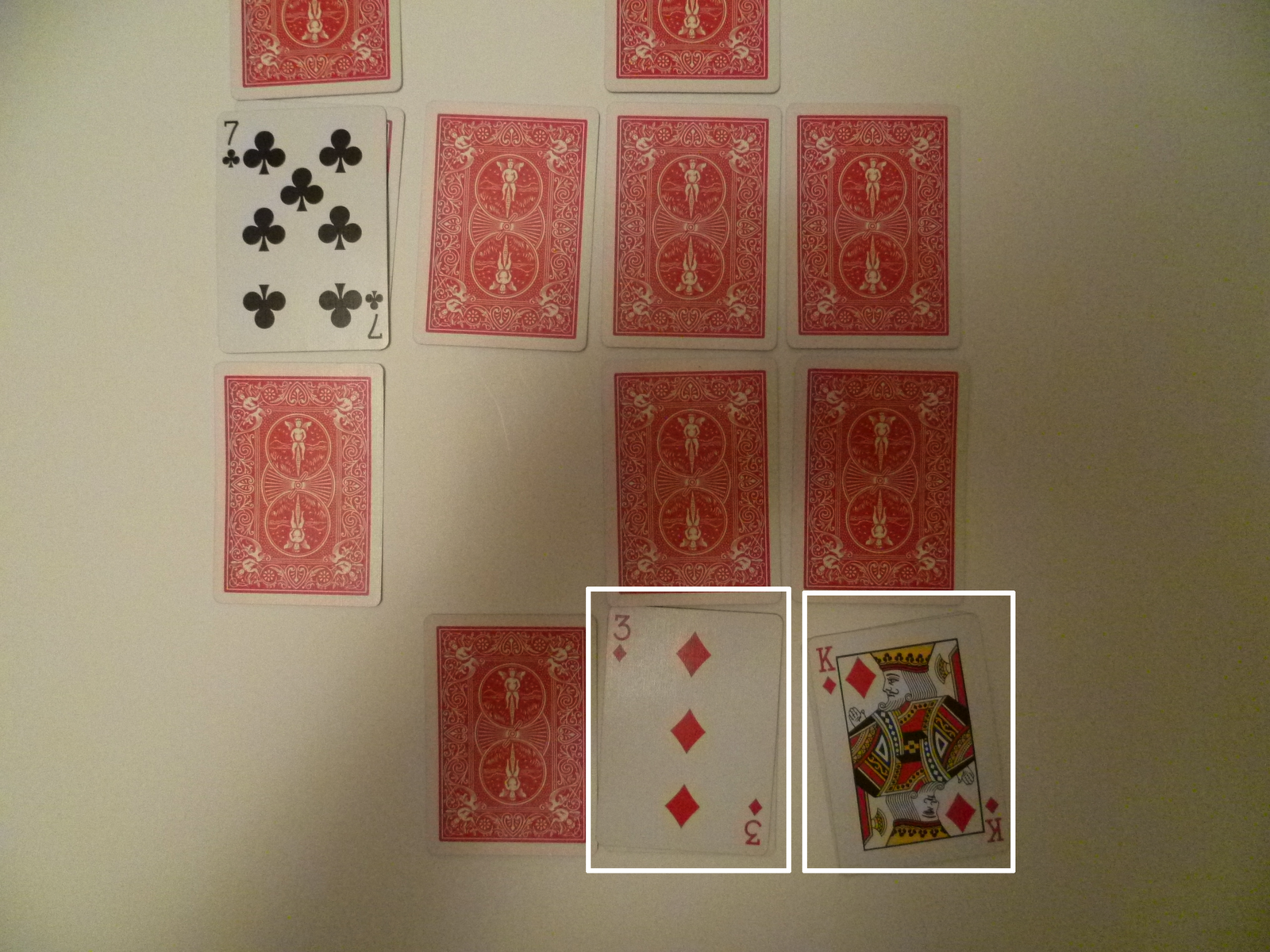
The black player picks up a wounded soldier with his seven of clubs and moves both of them back to his trenches.  The wounded soldier turned out to be a six of hearts.  Since the value of the wounded soldier (6) is less than or equal to the value of the soldier who did the rescuing (7) and the color of the wounded soldier is opposite that of the player, the rescued soldier gets placed in the infirmary.  Soldiers in the infirmary count toward the player's total number of soldiers at the end of the game, but cannot be sent back onto the battlefield to help rescue other wounded soldiers.


The red player moves his soldier from the trenches onto the battlefield.


X-coordinate of shell.


Y-coordinate of shell.


No able-bodied soldiers occupy that space, so the shell has no effect on gameplay.  Only one soldier occupies the battlefield, so only one shell falls.

Third turn:


The black player moves his soldier from the trenches onto the battlefield.


The red player picks up a wounded soldier with his king of diamonds and moves both of them back to his trenches.  The wounded soldier turned out to be a three of diamonds.  Since the value of the wounded soldier (3) is less than or equal to the value of the soldier who did the rescuing (K) and the color of the wounded soldier is the same as that of the player, the rescued soldier becomes able-bodied.  This soldier can be sent out onto the battlefield to help rescue other wounded soldiers.


X-coordinate of shell.


Y-coordinate of shell.

I forgot to take a picture of the battlefield here, but no able-bodied soldiers occupy the space where the shell has fallen.

Fourth turn:


The black player picks up a wounded soldier with his seven of clubs and moves both of them back to his trenches.  The wounded soldier turned out to be a jack of clubs.  Since the value of the wounded soldier (J) is greater than the value of the soldier who did the rescuing (7) and the color of the wounded soldier is the same as that of the player, the rescued soldier gets shuffled back into the black players deck.


From last turn, the red player now has two able-bodied soldiers to move.  For this turn, the red player stacks these two soldiers and moves them two spaces onto the battlefield.  The more soldiers a player has in a stack, the greater the range of movement for those soldiers.  Three soldiers in a stack means three spaces of movement for those soldiers.  Four soldiers in a stack means four spaces of movement.  And so on.


X-coordinate of shell.


Y-coordinate of shell.


No soldier is wounded by the shell.

Fifth turn:


The black player moves his soldier from the trenches onto the battlefield.


The red player picks up a wounded soldier and moves two spaces back to his trenches.  The value of the wounded soldier (9) is less than or equal to the value of the highest-valued soldier who did the rescuing (K).  The color of the wounded soldier is opposite that of the player, so the rescued soldier gets placed in the infirmary.


X-coordinate of shell.


Y-coordinate of shell.


No soldier is wounded by the shell.

Sixth turn:


The black player moves his soldier one space on the battlefield.


The red player moves both of his soldiers onto the battlefield.


X-coordinate.


Y-coordinate.


The red player's king of diamonds occupied the space where the shell hit.  The king becomes a wounded soldier.  This is signified by turning the king face down.  Now, the red player cannot do anything with the king unless he carries him off the battlefield.  It is also possible for the black player to carry this king off the battlefield.

I stopped taking pictures after this.  I hope this makes the rules of play clearer.  Maybe not.  I tried.

Cheers,

Danny

Thursday, August 2, 2012

WWI Part II

If you missed the first part, go read it.

Once again, the challenge: Design a non-digital game whose theme relates to World War I.  The primary objective of players cannot be territorial control or capture/destroy.  You must perform some amount of research while completing this project.

Flow of play:

The starting player is the player whose able-bodied soldier has the highest value.  Twos are low.  Aces are high.  Face cards do not share values, so a queen is higher than a jack.  If both players have an able-bodied soldier of the same value, roll dice to determine the starting player.

Each turn, every able-bodied soldier a player has control over can make one move.  These moves are described in detail below.  After the starting player has completed all of his/her moves, play passes to the opposing player who moves all of his/her able-bodied soldiers.

At the end of every turn, artillery shells fall onto the battlefield.  The number of shells is determined by taking the number of able-bodied soldiers currently occupying the battlefield and (using integer division) dividing by two.  Trenches are separate from the battlefield, so able-bodied soldiers in the trenches are not included in this calculation.  Integer division simply means to discard the fractional part of the result after division.  So, if there are three able-bodied soldiers on the battlefield, only one shell would drop.  3/2 = 1.5.  We drop the 0.5 which leaves us with 1.

This next part is easier to understand if you visualize the battlefield as a coordinate system.

The location of where each shell hits the battlefield is determined by two dice rolls.  For each shell that is to fall, the first roll determines the column the shell will land in (spaces are counted along the x-axis starting from the origin).  The second roll determines the row (spaces are counted along the y-axis starting from the origin).

If a roll is greater than the length of the battlefield, then the appropriate row or column can by found by using the remainder of the roll divided by the length of the battlefield.

If a shell lands on the same space that an able-bodied soldier occupies, then that able-bodied soldier becomes a wounded soldier.  Wounded soldiers are always presented face down, while able-bodied soldiers are always presented face up.  So when an able-bodied soldier is hit with an artillery shell, simply turn the card representing that soldier face down.  It is possible for more than one wounded soldier to occupy the same space on the battlefield.  If more than one able-bodied soldier occupies a space that gets hit by an artillery shell, all of those able-bodied soldiers become wounded soldiers.

If no able-bodied soldiers are present on the battlefield, then there is no reason for the players to roll dice to determine where the shells fall that turn because these shells would not have any effect on the game.

As stated earlier, each able-bodied soldier is allowed one move per turn.  These possible moves are detailed below.

For able-bodied soldiers in the trenches:
  • The player may choose to shuffle this soldier into his/her deck and draw a new soldier.  This new soldier is placed in the trenches and can do nothing further until the next turn.
  • This soldier may leave the trenches and enter the battlefield.  Once on the battlefield, this soldier is susceptible to artillery fire.  This move enables the soldier to be placed on any of the spaces that lines that player's trenches.  If the space chosen is occupied by wounded soldiers, enemy soldiers (able-bodied soldiers belonging to the player's opponent), or friendly soldiers (able-bodied soldiers belonging to player), simply place the able-bodied soldier on top of whatever cards already occupy that space.  It is also possible for a soldier to occupy an empty space of the battlefield (a space where a wounded soldier once laid, but has since been moved).

For able-bodied soldiers on the battlefield:
  • The player can move this soldier orthogonally (horizontally or vertically, not diagonally) one space from its current position.
  • This movement allows for the soldier to move onto any space of the battlefield.  As stated above, this includes the ability for the soldier to move onto a space occupied by wounded soldiers,  enemy soldiers, or friendly soldiers.
  • If a soldier occupies one of the spaces that lines the player's trenches, then that soldier may use its move to leave the battlefield and enter the trenches.  Soldiers in the trenches are safe from artillery fire.
  • Soldiers can not enter the trenches belonging to their opponent.
  • Before a soldier moves, if that soldier occupies the same space as a wounded soldier, rather than move from that space, this soldier may take a look at the color and value of the face down card representing the wounded soldier.  The importance of knowing the color and value of a wounded soldier is explained below. (Reminder: all wounded soldiers are presented face down on the battlefield)
  • In addition to simply moving around the battlefield and identifying wounded soldiers, a soldier can choose to pick up and move a wounded soldier.  A wounded soldier can be picked up if at the start of a turn, an able-bodied soldier occupies the same space as a wounded soldier.  The rules governing movement while carrying a wounded soldier are identical to the rules governing movement of an able-bodied soldier detailed above.
  • An able-bodied soldier cannot carry more than one wounded soldier at a time.

The goal is for players to carry as many wounded soldiers as possible back to their trenches before the chosen number of turns has elapsed.

What happens to wounded soldiers once brought back to the trenches?
  • If the wounded soldier rescued is the same color as the player who did the rescuing and the wounded soldier's value is less than or equal to the value of the able-bodied soldier who carried the wounded soldier back to the trenches, then this wounded soldier becomes an able-bodied soldier that can be deployed back onto the battlefield.
  • If the wounded soldier rescued is the opposite color of the player who did the rescuing and the wounded soldier's value is less than or equal to the value of the able-bodied soldier who carried the wounded soldier back to the trenches, then this soldier is too wounded to re-enter the battle.  This wounded soldier is placed in the infirmary.  Soldiers in the infirmary count towards the player's soldier count at the end of the game, but they cannot influence gameplay directly.
  • If the wounded soldier rescued is the same color as the player who did the rescuing and the wounded soldier's value is greater than the value of the able-bodied soldier who carried the wounded soldier back to the trenches, then the card representing the wounded soldier is shuffled into the player's deck.
  • If the wounded soldier rescued is the opposite color of the player who did the rescuing and the wounded soldier's value is greater than the value of the able-bodied soldier who carried the wounded soldier back to the trenches, then the card representing the wounded soldier is shuffled into the opposing player's deck.

Other important things that probably should've been mentioned already:
  • An able-bodied soldier carrying a wounded soldier can drop the wounded soldier.
  • If multiple wounded soldiers occupy the same space, only the wounded soldier at the top of the pile can be looked at or carried.
  • There is no direct interaction between able-bodied soldiers representing different sides of the conflict on the battlefield.
  • Able-bodied soldiers of the same team may be stacked.  Stacking increases the number of spaces these soldiers are allowed to move in a single turn.  If two soldiers are stacked, they can move two spaces.  If three soldiers are stacked, they can move three spaces.  And so on.
  • Stacked soldiers can still only carry one wounded soldier at-a-time.
  • If a group of stacked soldiers successfully brings a wounded soldier back to their trenches, the rules governing what happens to that wounded soldier are the same as those detailed above.  When determining the value of the able-bodied soldier that did the rescuing, use the value of the highest-valued soldier in the stack.
  • Once the specified number of turns has elapsed, all wounded soldiers still on the battlefield die.  This includes any wounded soldiers currently being carried by able-bodied soldiers.  The game continues, however, until all able-bodied soldiers make it back to the safety of their trenches.  Artillery shells continue to fall until the battlefield is cleared of all able-bodied soldiers.

Wow.  It all seems so convoluted now.  I promise the game makes more sense in practice.  I didn't realize how difficult it was to convey game rules and mechanics in writing.  Sorry for the disorganization.  Sorry for the lack of consistent voice.  It's a learning process.  Now I know some considerations I need to make when I attempt to detail my next game.  The miracle of progress!

I think some pictures might make things more clear.  Come back tomorrow for some pictures.

[Update 08/03/2012: Some pictures]

Cheers,

Danny